Table of Contents
Powder materials research often requires more than precise temperature control. When powders or granular materials are heated in a stationary bed, different parts of the sample may experience different thermal and atmospheric conditions. This can affect calcination, sintering, reduction, solid-state reactions, and other thermal processes.
A rotary rocking tube furnace introduces controlled movement during heating. By continuously rotating and rocking the furnace tube, powder materials are redistributed throughout the hot zone, helping improve thermal exposure, material mixing, and contact with the process atmosphere.
This makes rotary rocking tube furnaces particularly useful for laboratory-scale research involving battery materials, ceramic powders, magnetic materials, rare-earth materials, powder metallurgy, catalysts, and other advanced functional materials.
What Is a Rotary Rocking Tube Furnace?
A rotary rocking tube furnace is a laboratory tube furnace designed to heat powder or granular materials while the process tube rotates and rocks during operation.
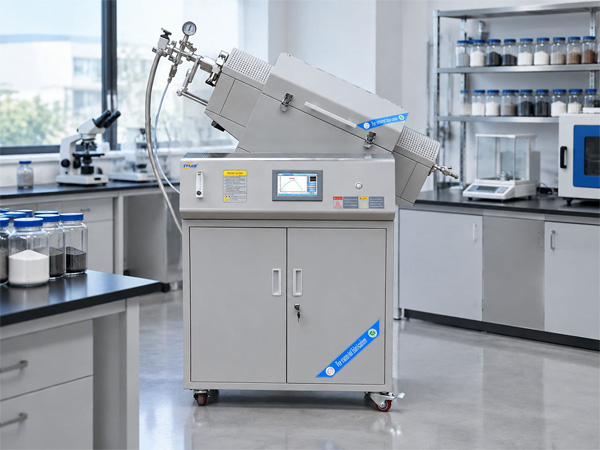
Unlike a conventional horizontal tube furnace, where the sample normally remains stationary, the rotary rocking mechanism continuously changes the position of the material inside the tube.
This dynamic movement can help:
- Redistribute powder during heating
- Increase contact between particles and the heated tube surface
- Renew contact between the powder and process gas
- Reduce localized accumulation or caking
- Promote more consistent thermal exposure
- Improve the repeatability of powder-based thermal processes
Research on rotating particulate beds has shown that particle movement can promote mixing and improve gas-solid heat and mass transfer, which is one of the fundamental reasons rotary thermal processing is useful for powders.
Why Does Powder Movement Matter During Thermal Processing?
In a conventional static tube furnace, a powder sample may form a relatively stationary bed.
The outer or upper portion of the powder can have different exposure to heat and process gas compared with particles located deeper inside the bed. The effect becomes more important when researchers are working with relatively large powder loads, reactive materials, or processes that depend strongly on gas-solid interaction.
A rotary rocking tube furnace addresses this by keeping the powder moving.
Static Powder Bed
Powder → stationary → limited redistribution → potentially different thermal and atmospheric exposure
Rotary Rocking Powder Bed
Powder → continuous movement → redistribution → improved thermal and gas exposure
The objective is not simply to make the powder move. The movement creates a more dynamic powder bed in which particles are repeatedly redistributed during the thermal cycle.
This can be particularly useful when the research process involves calcination, reduction, oxidation, sintering, drying, carbonization, or solid-state reactions.
Key Benefits of a Rotary Rocking Tube Furnace
1. Improved Thermal Exposure
As the powder moves through the heated zone, different particles are repeatedly repositioned.
This can help reduce the difference in thermal exposure between particles located at different positions within a static powder bed.
For materials research, this can be important when researchers are investigating:
- Phase formation
- Crystallinity
- Thermal decomposition
- Calcination behavior
- Sintering reactions
- Solid-state synthesis
Rotary systems are therefore particularly useful when powder movement is an important process variable, rather than simply heating a fixed sample.
2. Better Gas-Solid Contact
Many powder-processing experiments require a controlled atmosphere.
Depending on the material and process, researchers may use:
- Nitrogen
- Argon
- Hydrogen-containing reducing atmospheres
- Air or oxygen
- Other process gases
When powder continuously moves, fresh particle surfaces can be exposed to the surrounding process atmosphere.
This can improve gas-solid interaction during processes such as:
- Reduction
- Oxidation
- Calcination
- Carbonization
- Gas-solid reactions
- Controlled-atmosphere heat treatment
The importance of this mechanism is well established in rotary particulate processing, where particle movement contributes to mixing and gas-solid heat and mass transfer.
3. More Consistent Powder Mixing During Heating
Some material synthesis processes involve more than one powder component or require continuous redistribution during thermal treatment.
The rotary rocking motion can help maintain movement of the powder bed during heating, which is different from heating a pre-mixed powder that remains completely stationary.
This can be useful for research involving:
- Solid-state reactions
- Multi-component ceramic materials
- Battery material synthesis
- Catalyst precursors
- Magnetic materials
- Powder metallurgy materials
However, rotary movement does not replace appropriate powder preparation or mixing before the thermal process. It is better understood as an additional process mechanism that can influence powder behavior during heating.
4. Reduced Risk of Localized Powder Accumulation
During heating, some powders may tend to settle, compact, agglomerate, or form localized deposits.
Continuous movement can redistribute the material and help minimize prolonged contact between the same portion of the powder and the tube wall.
This can be beneficial for powders that are sensitive to:
- Agglomeration
- Uneven heating
- Localized reaction
- Caking
- Non-uniform gas exposure
The actual effect depends on powder properties, loading amount, particle size, moisture content, temperature, rotation/rocking conditions, and process atmosphere.
What Materials Can Be Processed in a Rotary Rocking Tube Furnace?
A rotary rocking tube furnace is particularly suitable for powders and granular materials used in advanced materials research.
Battery Materials
Battery R&D is one of the important application areas for rotary thermal processing.
Typical materials include:
- Lithium-ion battery cathode powders
- LiFePO₄
- NCM materials
- Graphite
- Other electrode materials
- Solid-state battery materials
Ceramic & Advanced Ceramic Materials
Ceramic powders often undergo high-temperature treatment before subsequent forming, milling, coating, or sintering.
Typical materials include:
- Alumina
- Kaolin
- Zirconia
- Functional ceramic powders
- Advanced ceramic precursors
- Non-metallic mineral powders
Magnetic & Rare-Earth Materials
Rotary rocking tube furnaces can also be used for thermal treatment and solid-state reactions involving:
- Ferrite powders
- Magnetic materials
- Rare-earth compounds
- Functional magnetic powders
These materials may require controlled heating and atmospheric conditions to achieve the desired phase or material structure.
Powder Metallurgy & Metal Powders
Powder metallurgy research often involves thermal treatment of metal or alloy powders.
Potential materials include:
- Metal powders
- Alloy powders
- Metal oxides
- Non-ferrous metal powders
Catalyst & Functional Chemical Materials
Catalyst preparation and functional material research can involve several thermal treatment stages.
A rotary rocking tube furnace can be used for research involving:
- Catalyst precursors
- Metal oxides
- Functional powders
- Chemical intermediates
What Thermal Processes Are Suitable for a Rotary Rocking Tube Furnace?
The same equipment can support different thermal processes depending on the material, temperature, atmosphere, and furnace configuration.
| Thermal Process | Typical Research Purpose |
|---|---|
| Calcination | Decomposition, phase formation, removal of volatile components |
| Sintering | Densification and bonding of powder particles |
| Solid-State Reaction | Reaction between solid precursor materials |
| Reduction | Conversion of metal oxides or other compounds |
| Oxidation | Controlled oxidation and material modification |
| Drying | Removal of moisture or volatile components |
| Carbonization | Thermal conversion of carbon-containing precursors |
| Thermal Treatment | Modification of physical or chemical properties |
The actual suitability depends on the material and required atmosphere. For example, processes involving oxygen-sensitive materials may require inert gas or vacuum conditions.
Rotary Rocking Tube Furnace vs. Conventional Tube Furnace
The key difference is sample movement.
| Feature | Conventional Tube Furnace | Rotary Rocking Tube Furnace |
|---|---|---|
| Sample position | Generally stationary | Continuously moves |
| Powder mixing during heating | Limited | Promoted by rotary/rocking motion |
| Gas-solid contact | Relatively static | Continuously renewed through movement |
| Powder redistribution | Limited | Continuous |
| Suitable samples | Powders, pellets, films, solid samples | Particularly suitable for powders and granular materials |
| Typical focus | Controlled heating | Controlled heating + dynamic powder movement |
| Research applications | Broad | Especially useful for powder-based thermal processing |
This does not mean a rotary rocking tube furnace is always better than a conventional tube furnace.
For films, wafers, pellets, fixed samples, or experiments where the sample must remain stationary, a conventional tube furnace may be more appropriate.
A rotary rocking tube furnace becomes particularly interesting when powder movement itself can improve the thermal process or is part of the experimental requirement.
When Should You Consider a Rotary Rocking Tube Furnace?
A rotary rocking tube furnace may be worth considering when your research involves:
✔ Powder or granular materials
The equipment is designed around the movement of particulate materials during heating.
✔ Controlled atmosphere
The process requires inert, reducing, or other controlled gas conditions.
✔ High-temperature powder processing
The material requires calcination, sintering, reduction, or another thermal treatment.
✔ Gas-solid interaction
The reaction depends on contact between the powder surface and the process atmosphere.
✔ Small-batch R&D
You need to evaluate materials or processes at laboratory scale before moving toward pilot-scale production.
✔ Repeatable material processing
You want to reduce the influence of static powder-bed behavior on experimental results.
ZYLAB Laboratory Rotary Rocking Tube Furnace
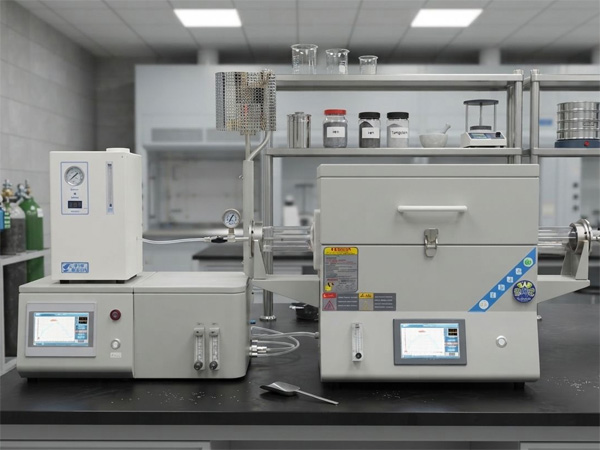
The ZYLAB Laboratory Rotary Rocking Tube Furnace is designed for batch thermal processing of powders and granular materials in material science and advanced materials research.
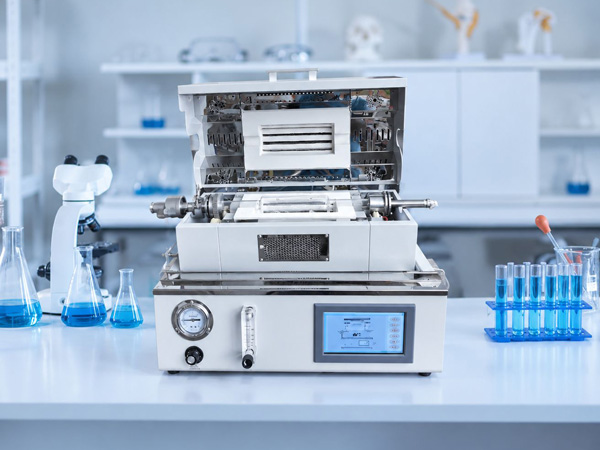
Its rotary rocking tube continuously moves the sample during heating, helping improve material redistribution, thermal exposure, and reaction consistency. The compact design is particularly suitable for university laboratories, materials research centers, and small-scale R&D projects.
Typical applications include:
- Battery materials
- Ceramic powders
- Rare-earth materials
- Magnetic materials
- Catalyst materials
- Powder metallurgy materials
- Non-ferrous metal powders
- Kaolin and other non-metallic minerals
The system can also be configured for vacuum or controlled-atmosphere processing, depending on the material and process requirements.
Conclusion
For powder materials research, temperature control is only one part of the thermal-processing equation.
How the powder moves during heating can also influence heat exposure, gas-solid contact, mixing, and reaction consistency.
A rotary rocking tube furnace combines controlled high-temperature heating with continuous powder movement, making it particularly useful for laboratory research involving battery materials, ceramics, powder metallurgy, catalysts, magnetic materials, rare-earth materials, and other advanced powders.
When choosing between a conventional tube furnace and a rotary rocking tube furnace, researchers should consider not only the required temperature and atmosphere, but also sample form, powder loading, gas-solid interaction, and whether the material needs to remain stationary or move during thermal processing.
For small-batch materials R&D where powder movement is an important part of the process, a laboratory rotary rocking tube furnace can provide a practical approach to controlled and repeatable thermal treatment.
Get In Touch
Fill out the form below — free quote and professional suggestion will be sent for reference very soon!
Share this entry
You might also like