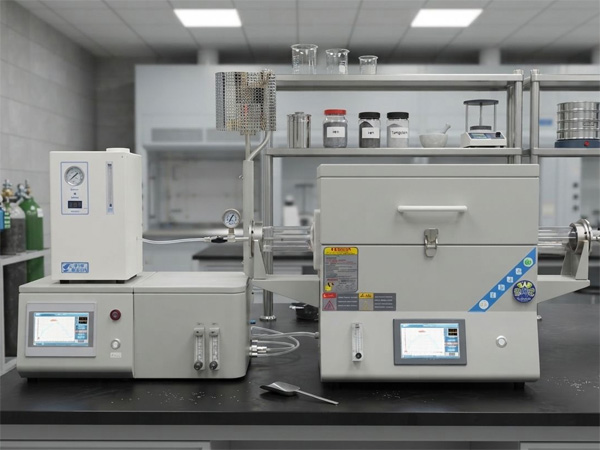
How to Set Up Nitrogen or Argon Gas Purging for a Laboratory Tube Furnace

Table of Contents

When heat treatment, annealing, calcination, or materials synthesis is performed in a laboratory tube furnace, exposure to air can affect the material and alter experimental results. For oxidation-sensitive powders, metals, ceramics, battery materials, carbon materials, and other advanced materials, researchers may therefore use nitrogen (N₂) or argon (Ar) gas purging to create a controlled inert atmosphere inside the furnace tube.

However, connecting an inert gas cylinder to a tube furnace involves more than simply opening the gas valve. The gas pressure, flow rate, purge procedure, tube sealing, and exhaust configuration all influence the atmosphere inside the reaction tube.

This guide explains how a nitrogen or argon purging system works with a laboratory tube furnace and discusses the key factors researchers should consider when setting up and operating an inert-gas heating system.

Why Use Nitrogen or Argon in a Laboratory Tube Furnace?

Ambient air contains oxygen and moisture that can participate in unwanted reactions during thermal processing. Depending on the material and temperature, this may lead to oxidation, changes in composition, surface reactions, or inconsistent experimental results.

Introducing an inert gas into the furnace tube helps displace air from the reaction zone and maintain a more controlled atmosphere.

Typical applications include:

  • Heat treatment of metals and alloys
  • Annealing of oxidation-sensitive materials
  • Ceramic processing
  • Powder metallurgy
  • Battery material research
  • Carbon material processing
  • Nanomaterial synthesis
  • Catalyst preparation
  • Calcination under controlled atmosphere
  • Thermal decomposition
  • Materials coating and CVD research

The choice of gas depends on the material chemistry and experimental requirements.

How Does Gas Purging Work in a Tube Furnace?

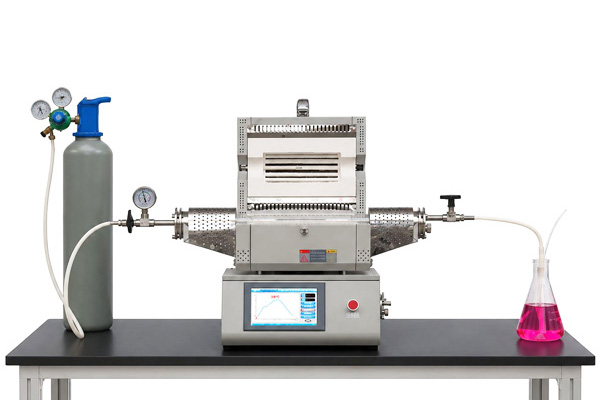
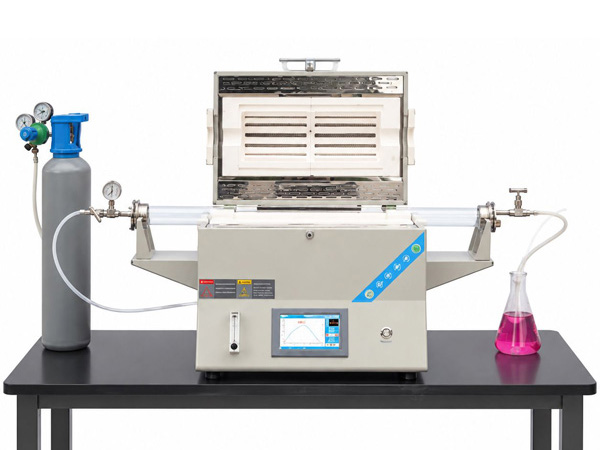
A typical inert-gas system can be arranged as:

Gas Cylinder → Pressure Regulator → Flow Control → Tube Furnace → Gas Outlet

The basic process is straightforward:

  1. Nitrogen or argon is supplied from a gas cylinder.
  2. A pressure regulator reduces the cylinder pressure to a suitable downstream pressure.
  3. A flow meter or mass flow controller regulates the gas flow.
  4. The gas enters the furnace tube and displaces air from the reaction zone.
  5. Gas exits through the outlet while the furnace follows the programmed temperature profile.

The purpose is not simply to fill the tube with nitrogen or argon, but to establish and maintain an atmosphere appropriate for the process.

Why Does a Tube Furnace Need a Gas Pressure Regulator?

Gas cylinders store gases at relatively high pressure, while laboratory tube furnaces generally require a much lower and controlled gas supply pressure.

A gas pressure regulator is therefore used between the cylinder and the furnace gas inlet.

Its main functions are to:

  • Reduce the high cylinder pressure
  • Provide a controlled downstream pressure
  • Protect the downstream gas line and furnace components
  • Provide more stable gas delivery
  • Allow the gas flow system to operate within its intended range

Pressure vs. Gas Flow: What Is the Difference?

One of the most common sources of confusion in gas-purging experiments is the difference between pressure and flow rate.

Gas Pressure

Pressure describes the force exerted by the gas within the system. The pressure regulator controls the pressure delivered from the high-pressure cylinder to the downstream gas line.

Gas Flow Rate

Flow rate describes how much gas passes through the system over a given period.

For example:

1 L/min nitrogen

describes a flow rate, not a pressure.

A tube furnace therefore normally requires both:

Pressure regulation + flow control

For basic laboratory applications, a pressure regulator combined with a suitable flow meter may be sufficient. For experiments requiring more precise and repeatable gas delivery, a mass flow controller (MFC) can be considered.

Initial Purging vs. Continuous Gas Purging

Gas purging can be divided into two basic stages: initial purging and continuous purging.

Initial Purging

Before heating begins, nitrogen or argon can be introduced into the tube to displace the air initially present inside the reaction chamber.

This is particularly important when the sample is sensitive to oxygen at elevated temperatures.

The required purge time depends on factors such as:

  • Tube internal volume
  • Gas flow rate
  • System sealing
  • Desired atmosphere
  • Gas purity
  • Experimental requirements

A larger tube or lower gas flow generally requires more time to replace the initial atmosphere.

Continuous Purging

In many applications, inert gas continues to flow during heating and holding.

Continuous purging can help maintain the desired atmosphere and compensate for small amounts of gas entering the system through connections or seals.

Depending on the process, researchers may also maintain inert gas flow during cooling.

For oxygen-sensitive materials, maintaining the inert atmosphere during cooling can be particularly important because the sample may remain chemically reactive while it is still hot.

Nitrogen vs. Argon: Which Gas Should You Use?

Both nitrogen and argon are commonly used as inert process gases, but they are not interchangeable for every material or process.

Factor Nitrogen (N₂) Argon (Ar)
Inert atmosphere Suitable for many applications Highly inert
Availability Widely available Widely available
Operating Cost Generally economical Generally higher
Materials Compatibility Suitable for many materials Preferred where greater chemical inertness is required
Typical Use General heat treatment and materials research Sensitive materials and processes requiring a highly inert atmosphere

Nitrogen is often a practical choice for general laboratory heat treatment and controlled-atmosphere processing.

Argon may be preferred when the material or reaction conditions make nitrogen unsuitable or when a more chemically inert environment is required.

The choice should be based on the material chemistry, processing temperature, required atmosphere, gas purity, and experimental objective, rather than simply the furnace temperature.

Conclusion

A laboratory tube furnace with nitrogen or argon purging is more than a furnace with a gas inlet. A reliable controlled-atmosphere system requires the right pressure regulation, appropriate gas flow, effective purging procedure, good sealing, and a suitable gas outlet configuration.

The key principle is simple:

Stable gas pressure + controlled gas flow + effective purging + good system sealing = a more consistent furnace atmosphere.

For routine materials research, nitrogen may provide a practical and economical inert atmosphere, while argon can be selected when greater chemical inertness is required. For applications requiring more precise atmosphere control, a pressure regulator, flow meter, MFC, vacuum system, or multi-gas configuration can be integrated according to the experimental requirements.

ZYLAB laboratory tube furnaces can be configured for nitrogen or argon gas purging, with options for gas flow control, vacuum operation, and multi-zone temperature control to support a wide range of materials research and thermal-processing applications.

Explore ZYLAB Laboratory Tube Furnace Solutions

Get In Touch

Fill out the form below — free quote and professional suggestion will be sent for reference very soon!