Table of Contents
Many advanced materials used in battery research, solid-state electrolytes, powder metallurgy, and materials science are sensitive to moisture and oxygen. Exposure to ambient air during processing can cause oxidation, moisture absorption, chemical reactions, or changes in material properties.
For these materials, conventional powder processing methods may introduce unwanted contamination or affect sample quality.
Jet milling is widely used in laboratory powder processing to reduce particle size through high-velocity gas streams and particle-to-particle collisions. However, when processing air-sensitive or moisture-sensitive materials, controlling the processing atmosphere is just as important as achieving the desired particle size.
One practical solution is to integrate a laboratory-scale jet mill into an inert atmosphere glove box.
By combining jet milling technology with a controlled argon or nitrogen environment, researchers can process sensitive powders while minimizing their exposure to ambient air and moisture.
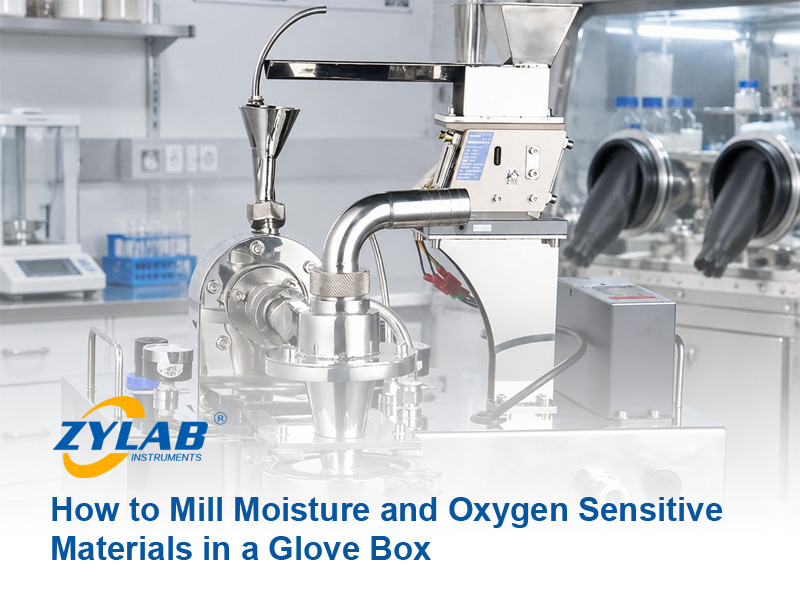
This article explains why glove box jet milling is important, how the system works, and what factors should be considered when selecting a jet mill for moisture- and oxygen-sensitive materials.
Why Are Some Materials Sensitive to Moisture and Oxygen?
Certain advanced materials can react with oxygen or water vapor even during relatively short periods of exposure to ambient air.
These reactions may affect their chemical composition, surface characteristics, particle properties, and subsequent experimental performance.
For example:
-
Oxidation: Reactive materials may form oxide layers when exposed to oxygen, changing their surface chemistry and potentially affecting their functional properties.
-
Moisture absorption: Hygroscopic powders can absorb water vapor from the air, resulting in changes in composition, flowability, or processing behavior.
-
Chemical reactions: Some materials, particularly sulfide-based solid electrolytes, can react with moisture and may release hazardous gases such as hydrogen sulfide.
-
Material degradation: Uncontrolled exposure to air or moisture may reduce the stability and performance of sensitive materials.
These challenges are particularly relevant to advanced battery materials, solid-state electrolytes, reactive metal powders, and other functional materials.
For this reason, maintaining a controlled atmosphere throughout powder processing is essential for applications that require strict environmental protection.
Why Use a Glove Box for Jet Milling?
A glove box provides a sealed working environment that can be filled with an inert gas, typically argon or nitrogen, depending on the material and process requirements.
Equipped with a gas purification system and oxygen and moisture monitoring, an inert atmosphere glove box can maintain low concentrations of oxygen and water vapor inside the working chamber.
When a jet mill is installed or integrated into the glove box, researchers can perform powder processing without exposing the material directly to the surrounding laboratory atmosphere.
The main advantages include:
1. Reduced Exposure to Oxygen and Moisture
The inert atmosphere helps protect sensitive powders from unwanted reactions with oxygen and water vapor during processing.
2. Controlled Powder Handling
Material feeding, milling, collection, and sample recovery can be arranged within a controlled environment, reducing the need to expose the powder to ambient air.
3. Improved Sample Integrity
Minimizing environmental exposure helps preserve the original characteristics of sensitive materials and supports more consistent research results.
4. Suitable for Advanced Materials Research
This configuration is particularly useful for laboratories working with air-sensitive battery materials, solid-state electrolytes, reactive powders, and other moisture-sensitive materials.
How Does a Glove Box Jet Mill Work?
A laboratory jet mill uses high-velocity compressed gas to accelerate particles inside a milling chamber. Particle-to-particle collisions generate the impact forces required for size reduction.
Unlike conventional mechanical milling equipment that relies on grinding media or rotating blades, jet milling can reduce particle size through collisions between particles.
When used inside an inert atmosphere glove box, the system combines this powder processing principle with environmental control.
A typical glove box jet milling process involves the following steps:
Step 1: Material Preparation and Feeding
The raw material is prepared and transferred into the glove box through an appropriate transfer chamber or sealed transfer arrangement.
The material is then introduced into the jet mill under the required atmospheric conditions.
Step 2: Jet Milling
Compressed gas is supplied through specially designed nozzles to generate high-speed gas streams inside the milling chamber.
The particles are accelerated by the gas flow and collide with one another, resulting in particle size reduction.
For air-sensitive materials, the milling gas and its supply arrangement should be selected according to the material’s chemical compatibility and process requirements.
Step 3: Powder Collection
After milling, the powder is carried by the gas stream toward the collection system.
A cyclone separator can be used to separate powder particles from the gas flow. The collected material can then enter a sealed stainless steel collection vessel, depending on the system configuration.
Step 4: Filtration and Gas Handling
An appropriate filtration arrangement may be incorporated to capture fine particles and manage the process gas.
The filtration system, exhaust routing, and gas circulation arrangement should be designed together with the glove box to prevent unwanted powder release or atmospheric contamination.
Step 5: Sample Recovery
The processed powder is collected and transferred into suitable sealed containers under the required inert atmosphere.
This helps minimize exposure to oxygen and moisture during the final recovery and storage stages.
Key Features to Consider When Selecting a Glove Box Jet Mill
Not all laboratory jet mills are suitable for installation inside a glove box. The equipment must be compatible with the available working space, atmosphere requirements, gas supply, and powder collection process.
The following factors should be evaluated before selecting a system.
1. Compact Design for Glove Box Installation
Glove boxes have limited internal working space. Therefore, a compact laboratory jet mill is generally more practical than a large industrial milling system.
2. Sealed Powder Collection System
Powder collection is an important part of inert atmosphere processing.
A sealed stainless steel collection vessel can help reduce direct contact between the collected powder and the external environment.
3. Cyclone Separator and Filtration System
A cyclone separator uses centrifugal forces generated by the gas flow to separate powder particles from the gas stream.
It provides an effective powder collection method for many laboratory jet milling applications.
4. Compatible Gas Supply and Atmosphere Control
Argon and nitrogen are commonly used as protective gases in laboratory powder processing. However, the appropriate gas depends on the chemical properties of the material being processed.
5. Easy Cleaning and Material Recovery
A suitable jet mill should allow convenient access to the milling chamber, collection vessel, and other powder-contact components.
The material of construction should also be compatible with the powders being processed.
Applications of Glove Box Jet Milling
Glove box jet milling is suitable for various advanced materials research and powder processing applications where controlled atmospheric conditions are required.
Typical application fields include:
1. Battery Materials
Used in lithium-ion battery research, including the processing of cathode materials, anode materials, and other battery-related powders.
2. Solid-State Battery Materials
Suitable for processing solid-state electrolytes and other sensitive materials used in next-generation solid-state battery development.
3. Powder Metallurgy
Applied in the preparation and processing of metal powders for powder metallurgy research and development.
4. Advanced Ceramics and Functional Materials
Used in the powder processing of advanced ceramics, electronic materials, magnetic materials, and other functional materials.
5. New Materials Research
Suitable for laboratory-scale powder processing in universities, research institutes, and industrial R&D laboratories.
Laboratory-Scale Jet Mill for Sensitive Powder Processing
For laboratories working with small quantities of advanced materials, a compact laboratory-scale jet mill can be a practical solution for particle size reduction.
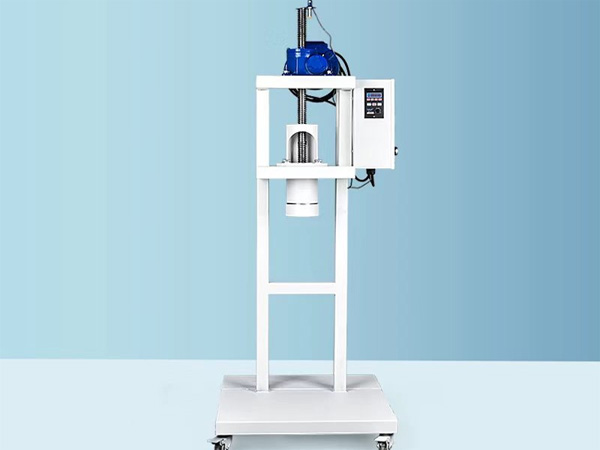
ZYLAB provides laboratory-scale jet milling equipment for powder processing applications in materials science, battery research, and other advanced material fields.
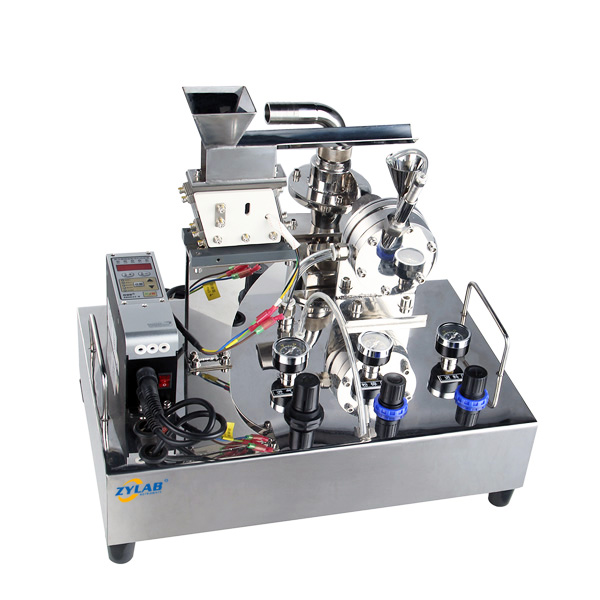
Depending on the application and system configuration, the equipment can be considered for integration with an inert atmosphere glove box.
Key configuration features may include:
-
Compact Laboratory Design: Suitable for laboratory-scale powder processing and space-limited working environments.
-
Cyclone Separator: Helps separate milled powder from the gas stream.
-
Sealed Stainless Steel Collection Vessel: Supports controlled powder collection and recovery.
- Optional Filtration System: Provides additional fine-powder capture according to process requirements.
Learn more about our Laboratory Scale Jet Mill for advanced powder processing applications.
Frequently Asked Questions
Q1: Which gas is suitable for inert atmosphere jet milling?
Argon and nitrogen are commonly used for inert atmosphere powder processing. The appropriate gas depends on the chemical properties of the material. Argon is often preferred for highly reactive materials, while nitrogen may be suitable for materials that are compatible with it.
Q2: What materials can be processed using a glove box jet mill?
Potential applications include selected lithium-ion battery materials, sulfide-based solid-state electrolytes, reactive metal powders, and other moisture- or oxygen-sensitive materials. Actual suitability depends on material properties and process conditions.
Q3: Can a laboratory jet mill achieve submicron particle sizes?
A laboratory jet mill may achieve submicron particle sizes with suitable materials and operating conditions. The actual result depends on material hardness, initial particle size, feed rate, gas pressure, and milling configuration. Milling trials are recommended to verify the target particle size.
Conclusion
Processing moisture- and oxygen-sensitive materials requires more than simply reducing particle size. Maintaining a suitable atmosphere throughout the entire powder processing procedure is equally important.
Integrating a laboratory jet mill into an inert atmosphere glove box provides a practical approach to processing selected air-sensitive powders while minimizing their exposure to oxygen and moisture.
By considering equipment dimensions, gas compatibility, sealing performance, powder collection, filtration, and safety requirements, researchers can develop a suitable jet milling solution for their specific materials and experimental objectives.
ZYLAB provides laboratory powder processing equipment and customized solutions for materials science, battery research, and advanced material development.
Case Study
Lab Scale Jet Mill Delivered to a U.S. Lithium-Ion Battery R&D Company
Get In Touch
Fill out the form below — free quote and professional suggestion will be sent for reference very soon!
Share this entry
You might also like