Table of Contents
Amorphous quartz, also referred to as amorphous silica or fused silica in many technical contexts, is an important high-performance material with excellent thermal stability, chemical resistance, low thermal expansion, and good optical properties. It is widely investigated for semiconductor, optical, photovoltaic, laboratory, and advanced materials applications.
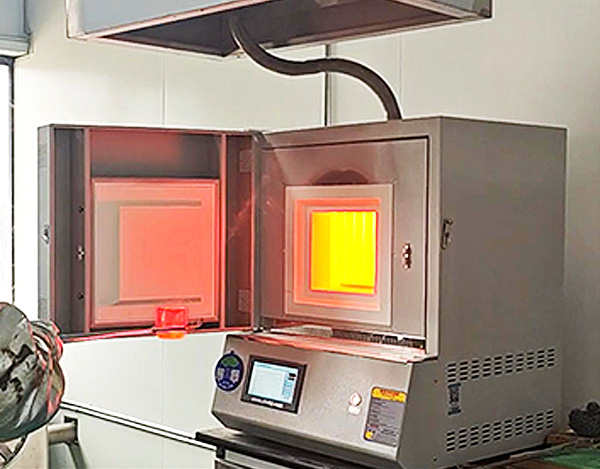
For the preparation of high-purity amorphous quartz materials, thermal processing is a critical step. A high-temperature sintering furnace provides controlled thermal and atmospheric conditions, allowing researchers to study densification, pore evolution, structural stability, and material purity.
Amorphous Quartz Sintering
Amorphous quartz preparation may begin with high-purity silica powder, amorphous silica particles, sol-gel-derived silica, or other silica precursors. During thermal treatment, particle rearrangement, neck formation, pore shrinkage, and viscous flow can contribute to densification.
A typical process can be simplified as:
Raw Material → Forming → Preheating → High-Temperature Sintering → Controlled Cooling
The final material properties depend strongly on the thermal profile and starting material characteristics.
Unlike crystalline ceramics, amorphous silica can undergo significant viscous flow at elevated temperatures. Therefore, excessive thermal exposure may cause dimensional deformation or affect the desired amorphous structure. Careful control of the sintering process is essential.
Importance of Temperature Control
Sintering temperature is one of the most important parameters in amorphous quartz research.
If the temperature is too low, insufficient densification and residual porosity may remain. If the temperature is too high or the holding time is excessive, unwanted deformation, contamination, or structural changes may occur.
Researchers therefore need to control:
- Peak sintering temperature
- Heating rate
- Holding time
- Cooling rate
- Temperature uniformity
A programmable high-temperature furnace allows different thermal profiles to be compared systematically, helping researchers identify an appropriate processing window.
Role of Controlled Atmosphere
For high-purity amorphous quartz research, atmosphere control can be as important as temperature control.
Processing under air, inert gas, or vacuum can produce different experimental conditions. Inert gases such as argon or nitrogen may be used when an oxygen-reduced environment is required, while vacuum processing can be used for specific material preparation and degassing studies.
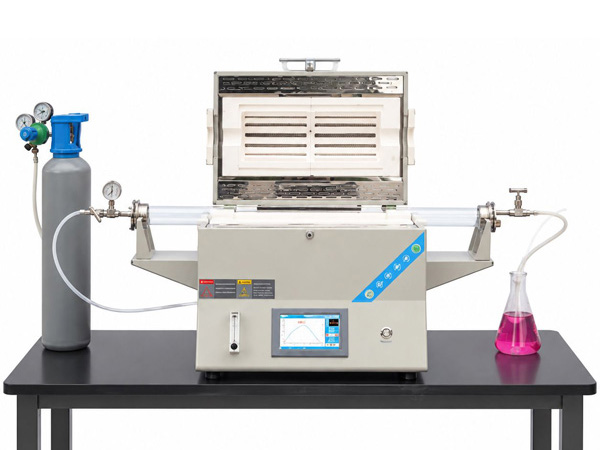
An atmosphere-controlled furnace can provide:
- Controlled gas inlet and outlet
- Stable gas flow
- Inert gas protection
- Vacuum processing, depending on configuration
- Reproducible experimental conditions
The appropriate atmosphere should be selected according to the silica precursor, impurities, additives, and intended application.
High-Purity Requirements
For advanced applications, maintaining material purity during sintering is critical. Contamination can originate not only from the raw material but also from:
- Heating elements
- Furnace insulation
- Crucibles
- Chamber materials
- Process gases
Therefore, furnace construction and material compatibility should be considered when developing high-purity amorphous quartz.
For semiconductor and optical materials research, contamination control can be particularly important because trace impurities may affect optical, electrical, thermal, or chemical properties.
Key Parameters for Furnace Selection
When selecting a high-temperature sintering furnace for amorphous quartz research, researchers should evaluate more than the maximum rated temperature.
Important parameters include:
| Parameter | Research Significance |
|---|---|
| Maximum operating temperature | Determines available processing range |
| Temperature uniformity | Ensures consistent sample treatment |
| Heating rate | Controls thermal gradients and process kinetics |
| Programmable temperature profile | Enables multi-stage experiments |
| Atmosphere control | Supports inert or specialized processing |
| Gas flow control | Improves process reproducibility |
| Vacuum capability | Enables reduced-pressure experiments |
| Chamber materials | Helps minimize contamination |
| Insulation materials | Influences thermal stability and purity |
A furnace designed for controlled high-temperature processing can therefore function as an experimental platform for optimizing amorphous silica preparation.
Characterization of Sintered Amorphous Quartz
After thermal treatment, characterization is essential for correlating furnace parameters with material properties.
Common techniques include:
- XRD: Evaluation of amorphous structure and possible crystallization
- SEM: Observation of morphology and pore structure
- Density and porosity measurements: Evaluation of densification
- FTIR: Analysis of Si–O bonding and hydroxyl-related features
- Optical characterization: Evaluation of transmission and absorption where applicable
Combining these results with sintering temperature, atmosphere, and holding time can help establish the relationship between processing conditions and material structure.
Research-Oriented Process Optimization
For high-purity amorphous quartz development, it is useful to treat furnace parameters as experimental variables.
Researchers can systematically investigate:
Temperature → Heating Rate → Holding Time → Atmosphere → Cooling → Material Properties
By varying these parameters while keeping other conditions constant, researchers can determine the optimal processing window for density, porosity, purity, morphology, and structural stability.
Conclusion
High-temperature sintering is an important process in the development of high-purity amorphous quartz and silica materials. A high-temperature atmosphere sintering furnace enables researchers to precisely control temperature and processing atmosphere, providing reproducible conditions for studying densification and structural evolution.
For research applications, the ideal furnace should combine accurate temperature control, good temperature uniformity, programmable heating profiles, atmosphere control, and contamination-conscious chamber construction.
These capabilities make high-temperature atmosphere sintering furnaces valuable tools for amorphous quartz preparation and advanced silica material research.
Get In Touch
Fill out the form below — free quote and professional suggestion will be sent for reference very soon!