Jet Milling Solutions for Binder-Free Dry Electrode Powder Preparation

Table of Contents

Introduction

Binder-free dry electrode technology is rapidly gaining attention in advanced lithium-ion battery research due to its potential for higher energy density, simplified processing, and reduced environmental impact. However, achieving uniform particle size distribution and maintaining material purity are critical challenges during powder preparation.

Binder-Free Dry Electrode Powder Preparation

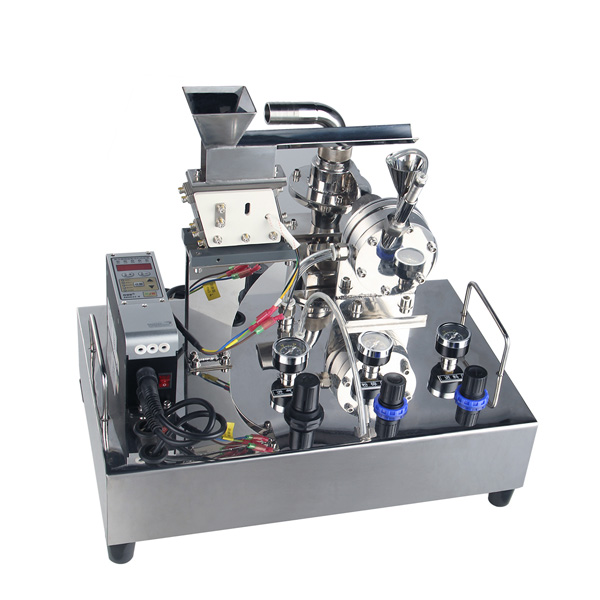
Jet milling offers an efficient and contamination-controlled solution for preparing dry electrode powders at laboratory scale. In this article, we explore how a lab scale jet mill supports binder-free dry electrode development, improves powder uniformity, and enhances electrochemical performance.

Why Binder-Free Dry Electrode Processing Matters

Traditional wet electrode fabrication relies on binders and solvents, which introduce several limitations:

  • Residual solvent contamination

  • Complex drying steps

  • Higher energy consumption

  • Environmental concerns

  • Reduced electrode density

Binder-free dry electrode processing eliminates solvent systems and enables direct powder compaction. However, this approach requires:

  • Precise particle size control

  • Narrow particle size distribution (PSD)

  • Minimal contamination

  • Stable morphology preservation

This is where jet milling technology becomes essential.

What Is Jet Milling?

Jet milling is a particle size reduction process that uses high-velocity compressed gas instead of mechanical grinding media. Unlike ball milling, there is no direct contact between moving grinding components and the material.

Key characteristics:

  • No metal contamination

  • Low heat generation

  • Excellent micronization capability

  • Adjustable particle size via air pressure and classifier speed

For battery material research, these advantages are particularly important when working with sensitive cathode and anode powders.

Role of Lab Scale Jet Mill in Dry Electrode Powder Preparation

A lab scale jet mill is specifically designed for R&D environments, pilot studies, and small-batch material optimization.

1. Precise Particle Size Control

Uniform particle size is critical for:

  • Improved electrode packing density

  • Better conductive network formation

  • Enhanced lithium-ion diffusion

Jet milling allows researchers to control D50 and PSD range by adjusting:

  • Grinding pressure

  • Feed rate

  • Internal classifier speed

This flexibility supports rapid formulation optimization during early-stage development.
2. Contamination-Free Processing

Binder-free dry electrodes are highly sensitive to impurities. Traditional mechanical milling methods can introduce:

  • Fe contamination

  • Wear particles

  • Surface oxidation

Jet mills eliminate mechanical contact surfaces, making them ideal for high-purity battery materials such as:

  • Lithium iron phosphate (LFP)

  • NMC cathode materials

  • Graphite anodes

  • Silicon-carbon composites

3. Low Thermal Impact

Many active battery materials are sensitive to temperature increases during grinding. Excessive heat can:

  • Alter crystal structure

  • Increase surface defects

  • Reduce electrochemical stability

Jet milling relies on gas expansion cooling, significantly reducing thermal stress during micronization.

4. Ideal for Binder-Free Electrode Architecture

Dry electrode fabrication requires:

  • Controlled particle surface area

  • Optimized particle-to-particle contact

  • Consistent mechanical interlocking

Jet milling enables fine-tuning of surface morphology without aggressive mechanical deformation, supporting stable dry electrode compaction.

Typical Laboratory Applications

A lab scale jet mill is commonly used in:

  • Lithium-ion battery material development

  • Solid-state battery research

  • Dry electrode process validation

  • Conductive additive micronization

  • Silicon-based anode powder refinement

Its compact design and flexible parameter control make it suitable for university labs, battery R&D centers, and pilot-scale material research facilities.

Conclusion

Binder-free dry electrode technology represents a significant advancement in next-generation battery manufacturing. However, its success depends heavily on precise powder engineering.

A lab scale jet mill provides:

  • Contamination-free micronization

  • Adjustable particle size distribution

  • Low thermal impact

  • Excellent repeatability for research optimization

For laboratories developing advanced lithium-ion and solid-state battery systems, jet milling is a critical step in achieving high-performance dry electrode powders.

Get In Touch

Fill out the form below — free quote and professional suggestion will be sent for reference very soon!