Table of Contents
Introduction
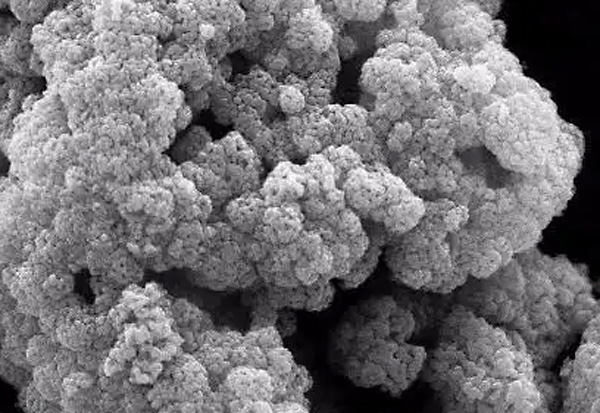
In high-temperature reduction processes—especially in hydrogen atmospheres—metal oxide powders often suffer from an undesirable phenomenon: sintering and agglomeration. This can significantly affect powder quality, reduce surface area, and limit downstream applications such as powder metallurgy, battery materials, and catalysis.
So, why do powders sinter during reduction, and how can this be effectively avoided? In this article, we explore the mechanisms behind powder sintering and provide practical solutions for researchers and engineers.
What Is Powder Sintering During Reduction?
Sintering refers to the process where powder particles bond together at elevated temperatures, forming larger aggregates or even dense structures. During reduction, this often occurs simultaneously with the chemical transformation of metal oxides into metals.
For example:
-
Fe₂O₃ → Fe₃O₄ → FeO → Fe
-
NiO → Ni
As metallic phases form, particles become more prone to sticking together due to increased atomic mobility.
Why Do Powders Sinter During Reduction?
1. High Temperature Activation
Reduction typically requires elevated temperatures (600°C–1200°C or higher). At these temperatures:
-
Atomic diffusion becomes significant
-
Particle surfaces become highly reactive
-
Neck formation between particles is accelerated
This leads directly to sintering.
2. Formation of Metallic Bonds
During reduction, metal oxides are converted into pure metals. Compared to oxides, metal particles have higher surface energy and stronger atomic bonding, which promotes:
-
Particle coalescence
-
Grain growth
-
Loss of powder dispersion
3. Surface Diffusion and Mass Transport
Sintering is driven by diffusion mechanisms, including:
-
Surface diffusion
-
Grain boundary diffusion
-
Volume diffusion
These mechanisms cause particles to merge and reduce overall surface energy.
4. Poor Powder Movement (Static Bed Problem)
In traditional static furnaces:
-
Powders remain stationary
-
Local overheating can occur
-
Gas-solid contact is uneven
This creates ideal conditions for localized sintering and hard agglomerates.
5. High Gas Concentration and Reaction Rate
In hydrogen reduction:

-
Fast reduction rates can lead to rapid nucleation of metallic particles
-
This increases the probability of particle contact and bonding
Why Is Sintering a Problem?
Uncontrolled sintering can cause:
-
❌ Loss of powder flowability
-
❌ Reduced specific surface area
-
❌ Poor reactivity in subsequent processes
-
❌ Difficulty in downstream processing (pressing, coating, etc.)
For industries like battery materials or powder metallurgy, this can directly impact product performance.
How to Avoid Powder Sintering During Reduction
1. Optimize Reduction Temperature
-
Use the lowest effective reduction temperature
-
Avoid unnecessary overheating
-
Apply multi-stage heating if needed
2. Control Heating Rate
-
Avoid rapid temperature ramp-up
-
Gradual heating reduces thermal stress and sudden particle bonding
3. Adjust Gas Flow and Atmosphere
-
Optimize hydrogen concentration and flow rate
-
Avoid excessive reduction speed
-
Use diluted hydrogen (e.g., H₂ + N₂) when appropriate
4. Reduce Residence Time
-
Minimize the time powders stay at peak temperature
-
Use fast heating and cooling cycles when possible
5. Improve Powder Dispersion
-
Pre-treatment such as milling can help
-
Avoid large particle clusters before reduction
6. Use a Rotary Hydrogen Furnace (Most Effective Solution)
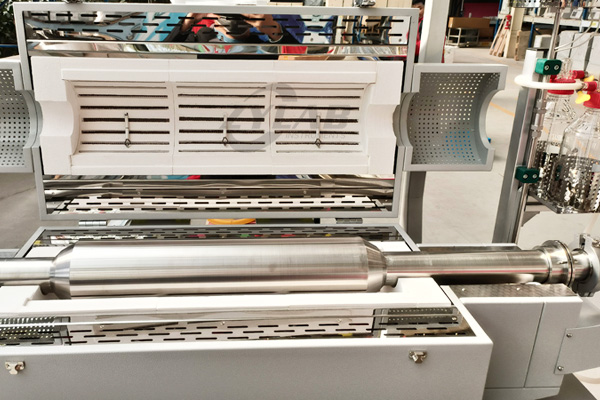
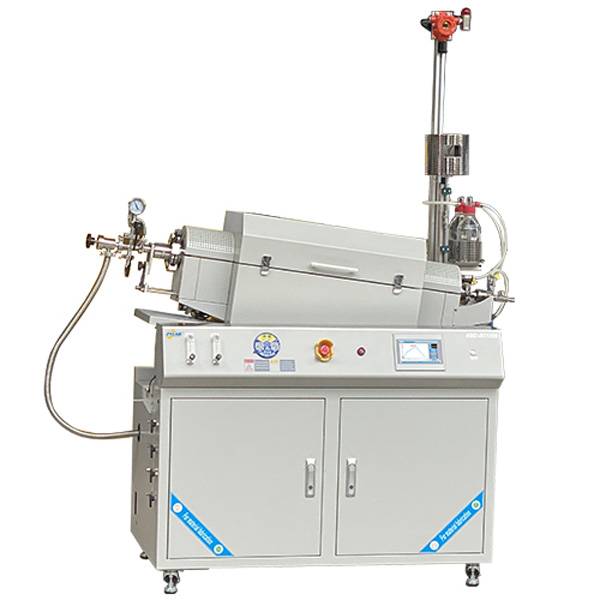
One of the most effective ways to prevent powder sintering is to use a rotary hydrogen furnace instead of a static system.
Why Rotation Matters
A rotary furnace continuously rotates the tube, ensuring that powders:
-
✔ Remain in constant motion
-
✔ Do not stay in contact for long periods
-
✔ Are evenly exposed to temperature and gas
-
✔ Avoid local overheating
Key Benefits
-
Prevents agglomeration through dynamic movement
-
Improves uniformity of reduction
-
Enhances gas-solid interaction
-
Supports continuous processing
Why Choose ZYLAB Rotary Hydrogen Furnace?
ZYLAB’s rotary hydrogen furnaces are specifically designed for powder reduction applications, offering:
-
Multi-zone precise temperature control
-
Stable and safe hydrogen atmosphere system
-
Adjustable rotation speed for different materials
-
High-purity tube options (quartz, alloy, etc.)
-
Customizable configurations for research and industrial use
These features make it an ideal solution for:
-
Metal powder production
-
Battery material processing
-
Advanced material research
Conclusion
Powder sintering during reduction is a common but manageable challenge. It is mainly caused by high temperature, diffusion mechanisms, and static processing conditions.
By optimizing process parameters—and more importantly, by adopting rotary hydrogen furnace technology—it is possible to significantly reduce agglomeration and achieve high-quality, uniform powders.
Get In Touch
Fill out the form below — free quote and professional suggestion will be sent for reference very soon!